Edit-a-thon at MoMA

Fixing Wikipedia’s Gender Bias

Wikipedia suffers from a lack of women editors, profiles, and contributors. One source says that only 15% of contributors are female, and in 2011 only 8.5% of Wikipedia editors were women. This is a problem because Wikipedia is commonly understood as the online repository and record for knowledge. Incomplete representation of the world both perpetuates inequality and writes a false history.

However, the complete picture of Wikipedia’s gender imbalance is actually a hopeful one. Inequality is a problem, but denial of its existence makes amelioration impossible. In line with its founding principles as a democratic, user-driven site, Wikipedia acknowledges its lack of women-related content and editors and calls for action.

This past weekend, to coincide with International Women’s Day, many arts and cultural organizations co-hosted Art+Feminism “edit-a-thons” with Wikipedia. At the Museum of Modern Art Lewis B. and Dorothy Cullman Education and Research Center, volunteers trained women on how to become Wikipedia contributors and helped newly-minted contributors actually write and improve posts. We targeted a running list related to women in the arts that needed articles created or strengthened.

Wikipedia Training

Senior Wikipedians trained participants all day 

Lucy edit-a-thon

Lucy Drummond created French artist Camille Henrot’s Wikipedia page

The demographic of attendees was representative of the goals the Wikipedia community is working towards. There were more than a hundred people of different ages, ethnicities, and backgrounds who come to the MoMA to improve the internet’s encyclopedia.

Woman Editing

Wikipedia Check In

It is not just the art world that has benefitted from such targeted edit-a-thons. Sibyl M. Rock, a woman instrumental to developments in mass spectrometry and the early digital computer Datatron at the CEC, did not have a Wikipedia page until Brown University hosted a 2013 women in science Wikipedia edit-a-thon. A lot of other women in technology have been recognized thanks to these efforts.

Sibyl Rock

Sibyl M. Rock

It is huge for one of the most popular websites in the world to acknowledge unequal gender representation, and invite its community to fix this problem. This represents the internet at its best: devoted to the people and calling for user participation. Furthermore, the solution the Wikipedia community implemented this past Saturday involves IRL (in real life) community strengthening. Using the internet to improve lives off of the internet is what a 21-st century connected, global network should be. In true feminist form, there was even a room on-site this weekend for sponsored child-care.

Edit-a-thon child care

Society, especially as concretized through the internet’s encyclopedia, needs women’s voices. We must give credit where it is due, and include women both in the content and creation in Wikipedia.

Lucy Drummond

Big Data May Not Be Inclusive Enough

By Lucy Drummond

Before we analyze and celebrate the “insights” so far gleaned from big data, we need to look at who is analyzing and collecting the data.

In the 1980’s, research on heart attacks and blood pressure was published as a necessary read. However, only when gender-conscious thinkers approached the material did they realize that the research participants were almost all men. How could the physiological differences between males and females not warrant specific analysis, or at least, acknowledgement? Men and women have entirely different hormones, bone densities, and reproductive systems.

It turns out that gender does influence one’s heart and blood, and now health recommendations for men and women vary. Even if the variation is slight, the point is that the way the initial research was structured was not inclusive enough to reveal accurate results.

We are about to have a similar phenomenon with big data. Of course, big data is not vital like the human heart. But there are parallels to be drawn about the ways in which measurement tools are devised. If there are mostly men at the drawing board, only certain kinds of information will be recorded. We need a diverse group of people structuring the ways we measure the world.

An August 2015 article in Network World spotlighted thirteen up and coming big data analytics companies. Unfortunately, only three have a female employee. None have more than one female employee. Experfy and Interana each have one female co-founder, and DataTorrent is the only other company besides those two that even has a female employee. RapidMiner has raised $20 million, but seven out of seven of their employees are men; Snowflake Computing, which has accrued more than $65 million, has six total male employees; at $41 million, Tamr’s four employees are men.

This is not a statement condemning or blaming men. It is a call to action for those involved in big data. We are asking data scientists, analysts, managers and engineers to pause and think: are there enough viewpoints and backgrounds included in the earliest stages of structuring big data tools? Are we addressing the qualitative, in addition to quantitative stats? Valuable insights can be gleaned by assessing information in different ways. A complete and thorough rubric is the only thing that will yield accurate results.

Innovation Old vs. New

This week my husband and I had one of our conversations about innovation. I see innovation blooming all over in early-stage companies that aim to improve our experience and offer a new generation of products incorporating technology. My husband was a Global Research Director at a major Wall Street firm, so he has an excellent viewpoint on public companies, the markets and the full range of investment products. I worked on Wall Street, too, but as an investment banker helping companies raise capital in the public and private markets.  Now, I live in the completely different world of the startup ecosystem, where people are creating new technology, products and businesses.

Our conversation started off as it does many times. I was talking about an example of an early-stage company doing something that is done by a big corporation – only the small company is using technology and can do what that they do better, cheaper and faster. We then delved into a discussion about the merits and value of old line business and new transformative companies.

A few weeks ago, I saw a post from Blackrock’s Chief Investment Officer about the new mega trend of public companies buying back their shares. CB Insights picked up on the article and made some powerful points about when companies cannot find auspicious opportunities to deploy their capital, they buy back their shares in the public markets.  When it comes to innovation, start-up companies can move faster and experiment and iterate until they find the solution or the right model. Having worked in both established corporations and with early stage companies, I would put my money on start-ups for fast and big innovation.

This cartoon captures for me what I believe is happening.

1

There are new entrants into every industry that are decentralizing the services and delivery of goods. Not every company will make it, but each company offers a movement forward on the innovation path. No company jumps in and creates a new direction. Innovation happens in small increments, often with different companies contributing to the evolution.

This is a time of explosive innovation and change that can only come about with adequate capital to the most promising founders and ideas. This is a call to action for women to found companies to invent and offer products that we really want. This is a call to action for men who are founding companies to include women in your founding team–especially if your products are for women.  And it is a call to investors to consider what it means for gender and other types of diversity.

Engagement in the Workplace

By Maggie Cely

At Plum Alley, we have long believed in the benefits of women founding and investing in companies. Now, there is evidence to say that women remaining in those companies as part of the leadership is beneficial for the bottom line.

“A highly engaged workforce means the difference between a company that thrives and one that struggles. When employees are engaged, they are passionate, creative, and entrepreneurial, and their enthusiasm fuels growth.”

Gallup’s article Q12 Employee Engagement concluded with this resounding statement on the correlation between engagement and financial growth. It makes sense – employees that receive acknowledgment for their triumphs, have open communication with their superiors, and are encouraged to grow are productive members of their team and, therefore, company.

One would presume that American companies would be partial to this variety of leadership to drive profits, encourage growth, and improve efficiency.

Statistically, the managers with the highest level of engagement are women; however, women only make up one-third of all workplace leadership roles in the U.S. Apparently, efficiency is no match for gender bias.

Entrepreneur magazine summarized findings from a series of Gallup studies regarding the state of managers and employees in the workplace, finding that women excelled at 11 of 12 categories of employee engagement over men. They broke down the information into 5 digestible ways women employ these engagement tactics to improve employee performance, number one being that women are generally more engaged themselves. Inspiring personnel development, offering regular feedback and praise, and an overall strong moral compass were additional reasons named.

Gallup also looked into who worked best under whom – does a male work most effectively under a man or woman?

It turns out that men and women varied most at engaging their own gender, yet the co-ed teams were relatively consistent. Men engaged their male employees at a rate of 25%, and females at a rate of 35% with female employees. These figures are a bit puzzling, given that the most engaged team dynamic, a female boss with female employees, is the least prevalent.

PreferenceOfBossGender-R2_Engagement

Another strong note was the study of preference and how attitudes have changed over the past 60 years. In the 50’s, an overwhelming majority (two-thirds) of Americans preferred a male boss, 5% a female boss, and 25% claimed ambivalence. In 2014, one-third of Americans preferred a male boss, 20% preferred a female boss, and the majority (46%) had no preference.

PreferenceOfBossGender-R2_Leadership (1)

In regard to preference, working underneath a specific kind of human no more shows a gender bias than choosing to work at a startup shows a size prejudice. It’s merely preference, what works for you as an employee.

The major issue is that having a female boss is substantially less likely than having a male boss, so employees are forced to work within the confines of structural inequality that stems from promotional bias. In other words, you can have a preference, but you can’t really have a preference.

Notwithstanding these findings, progress is on the horizon. COO of Facebook Sheryl Sandberg just unveiled a training program to recognize and challenge unconscious bias in the workplace, beginning with her own team. Dozens of organizations that promote women in tech and other male-dominated industries are growing in popularity and prevalence (see Tech Ecosystem Infographic).

How do we continue the trajectory towards change? Literature on the subject alone is not enough to change perceptions. Rather, infusing women’s entrepreneurial ventures with capital, encouraging women to invest and to be involved in investment decisions, diversifying teams, and promoting staff with the credentials to perform and the ability to engage are imperative initiatives to change the landscape and stimulate growth, financial and otherwise.

AngelList_BlogHeader-4

Solving Silicon Valley’s Gender Imbalance

AngelList, founded in 2010, is a new way to use the internet to fund companies. Founded by Babak Nivi and Naval Ravikant, AngelList provides a service to both investors and entrepreneurs. Entrepreneurs can easily upload information about their companies and can be discovered by investors in Silicon Valley and elsewhere. Investors can find new opportunities easily and invest in companies.

AngelList exemplifies the power of what can be done online and can potentially disrupt the closed network of venture capital allocation. AngelList has expanded its services to things like job postings, syndicates and more. Syndicates are often led by a person with a track record and considerable early stage investing acumen. They allow for less known or less experienced investors to invest alongside bigger names.

Plum Alley has been closely watching the progress of AngelList in the last three years. We are highly supportive of its mission to provide more transparency to the closed, elite world of venture capital, to lower fees and to better align compensation with performance.

AngelList has the potential to transform the entire landscape of early stage investing. Its business model is still in formation and the platform is experimenting with a compensation model that is radically different from the 2% management fee and 20% carry (upside) that have made traditional VCs very rich.

We were curious to see how AngelList is impacting the flow of capital to companies with female founders and gender diverse teams. AngelList is growing rapidly, so the numbers are a moving target. We acknowledge that complete information is not readily available on all the companies and the investors who are registered on the platform. We analyzed the data that was available for the year of 2014. While the numbers may have shifted a little bit from the date of our research, we believe that our conclusions would still hold true today. Here is what we found when looking at companies, investors and syndicate leaders by gender.

Companies funded on AngelList

We were able to find information on 212 of the 243 startups that were funded through AngelList in 2014. Out of these companies, 86.3% have all-male founders. Only 11.8% have gender-diverse founding teams, and 1.9% have all female founders.

PlumAlley_AngelList_Companies

This means that out of those who receive capital on AngelList, at least 90% are men. We find this data puzzling because we know that there is a huge number of women entrepreneurs and females starting companies who need capital.

PlumAlley_AngelList_WomenBusinesses

While we are disappointed to see the data, we know that activity on AngelList simply reflects the dominant demographic of players in Silicon Valley. We all need to look deeper to find out what causes a low representation of women entrepreneurs who get funded and women who invest in early stage companies. The number of smart ideas and companies is endless, and only limited by access to capital. As platforms emerge to provide more efficient and new ways to obtain capital, we all need to do our part to make sure the opportunities are equal for both genders and all other groups.

A Gender Breakdown of Investors on AngelList

On the investor side, things were not much different. Out of the 216 most active angel investors whose data we were able to access, only eight are women and 207 are men. (One angel position is occupied by a couple.)

PlumAlley_AngelList_Investors

This means that at least 95.8% of the active investors on AngelList are men. This too is disappointing.

Women control $11.2 trillion of investable assets in the U.S. alone, yet $5 trillion goes unmanaged. This amount of capital can have a major impact if more women are activated as investors.

PlumAlley_AngelList_PotP

We know that women have the money. They are looking for transparent investment opportunities that are consistent with their values and will provide a return. They value meaning and purpose and are willing to take risks that they understand.

Syndicate Leaders by Gender

In 2014, there were 135 active syndicates on AngelList in our sample. Only nineteen, or 14%, are led by women.

PlumAlley_AngelList_Syndicates copy

It is important to recognize that a few enlightened leaders on AngelList are actively seeking women investors and to fund female and diverse founding teams. 500 Startups offers a dedicated syndicate for female founded companies called 500 Women. Our belief is that female founded companies represent an untapped source of outstanding companies with massive potential. The industry must be careful not to segment the market into men only investing in men and women only investing in women.

Conclusion

In our sample, the vast majority of companies seeking capital on AngelList have all male-teams, and more than three quarters of the site’s investors are men.

In many ways, the record of funding on AngelList is similar to the funding record of the top VC’s in 2014 that we have written about before. If you are a woman entrepreneur looking for funding, would you consider AngelList?

While AngelList is using technology to improve access and transparency, and reduce fees, there is more the industry needs to do to open the doors for women entrepreneurs and gender-diverse teams. We must fund great ideas and companies from women and diverse teams that have equal merit to all-male founded companies. To spur innovation and job creation we need all worthy entrepreneurs to succeed, and those who are in a position to support must do so.

The solution to changing this gender imbalance rests with both women and men. First, we need the industry to acknowledge the problem. Then, we encourage everyone involved in allocating early stage capital to support all efforts underway to level the playing field. It’s a winning solution for all.

As for women, Plum Alley and others are initiating meaningful ways for you to participate and invest. It is time to put your money behind your beliefs, fund women entrepreneurs and participate in the wealth creation taking place.

SoulCycle

The Decade of the Female Entrepreneur

Julie Rice and Elizabeth Cutler, courtesy Inc.com

By Deborah Jackson

Thank you SoulCycle.

If you haven’t tried the popular sweat-inducing aerobic exercise for 45 minutes that has caught on like wildfire in urban areas, you must be out of the country. I first discovered SoulCycle in 2011 when I was looking for an alternative to a boot camp I did with my friend, who also gave birth to two daughters at the same time over 20 years ago. We felt it was time to do something about the weight gain that naturally occurs in our age bracket. After a year of boot camp, I needed an alternative way to get exercise. I tried SoulCycle as part of a special Gilt offer that included a pair of my very own bike shoes. SoulCycle was desperate to get new customers; my 3-class package with shoes was $30.

The studio on West 18th was new, empty and candlelit. I loved the class–I was physically challenged but also emotionally and spiritually recharged. I became a devotee and at every holiday my go-to gift was more classes at SoulCycle.

SoulCycle in 2015 is similar and different. I was there today and as I was racing to catch up, I looked around and noticed what I notice at every visit: the room was dominated by women. There are always a few men who come with their partner or their girlfriend. But, the place is by women for women.

This company just filed their S1 to go public. I pondered that as I was trying to distract myself from the increasing resistance on the petal.

This is huge. This company was founded by two women who were looking to create a cycling space and approach that worked for them. The gym space and exercise options are so prolific that it is hard to image another one. Yet somehow Soul Cycle is thriving, has a cult-like following and grows through word of mouth. A founder’s dream.

The existing options at gyms and stand alones were not doing it for Elizabeth Cutler and Julie Rice, SoulCycle’s founders. These women built the first space with the features they wanted–an accepting environment that also pushes you to work hard. The ambience at SC is about plugging into something more than just physical prowess. Instructors ask you to close your eyes and visualize your dream, or think about how your soul is showing up for your body.

Brilliant, Elizabeth Cutler and Julie Rice. You knew what you wanted, and you knew that other women wanted it too.

This is what the next decade will be. This is the decade of the women entrepreneur. Women are starting to build the companies and products that they want. The competition is irrelevant–women are building things that will go viral.

Women have founded rockstar companies in the consumer product space–think Spanx; Ringly; Goldieblox. For software, we have Learnvest; for health care there is Maven. The biggest thing that has enabled women entrepreneurs is technology and the internet. You can find customers and get publicity without massive amounts of money.

The world is changing and women are taking the lead. They are building the products that they want. This is game changing because women know the customer as they are the consumer. Women are not a niche market. They control spending for food products for the the family, clothing and medical care. I predict the rise of the woman entrepreneur in this decade because she is building the products that women want.

Just like SoulCycle, women build products that connect you with more–either your soul or your values.  These products also treat you like you matter. Because you do.

Capital Chain Graphic

Raising Early Stage Capital: A 10 Step Guide

People with great ideas need money and resources to help them build companies and succeed. The battle for early stage capital is fierce, but understanding the nuance in the process can be helpful to more mindful targeting and an informed approach. We have outlined ten easy steps to help you evaluate what sort of capital best fits your early stage company.

1. Start with knowing what stage your company is in. Are you still in the idea phase or have you built a prototype? The further along you are the easier it will be to raise money.

2. Understand how you will make money in the future. You need at least a basic revenue plan before you seek to raise capital. What do you offer? How much will customers pay? How many customers do you need to break even, and where will you find them?

3. Decide if you need to test your idea. We recommend rewards-based crowdfunding as you can develop your idea without giving away equity. You can ask for orders of your new product and receive the cash you need for a manufacturing round. Supporters like friends and family who want to contribute to your success can also do so at a much lower level than angel or institutional investors. Crowdfunding is the first step in the chain of capital raising, as you can see on the chart below.

4. Rewards-based crowdfunding is a great way to further your business before going on to other rounds of funding. You will build an active relationship with your supporters, demonstrate traction, and have the opportunity to refine your product or mission after this experience. There is no equity given away and the process is low risk.

On Plum Alley, we have interactive technology and customer support to help you succeed in your rewards-based crowdfunding campaign.

5. Venture capitalists will ask if you have completed a successful crowdfunding campaign as part of their due diligence. Why? Because it shows you know how to sell your product, and your customers want it. The hustle on a CF campaign is easier than raising outside angel or VC money, and it shows you have the drive to succeed.

6. After you have a product and demonstrate that customers will pay, then consider angel investors. The amount angels fund will be enough for you to get your company off the ground to build a team, acquire users and get press. Choose your investors wisely. If you can find investors with domain expertise like technology, that is the best.

7. After you have built your product, have paying customers and a team, it is time to consider VC funding to accelerate your growth.  There are many sources of money but they are not equal. Beware of investors who are not aligned with your vision and offer to help but don’t deliver. Check the references of investors and VC firms. In most VC firms, the ratio of companies to VC partner is 50 to 1. You can imagine how much time they will actually spend on your company until there is a problem.

8. Outside funding is certainly powerful and will help your company grow. However, outside capital is not a business model. You need to know how you will make money in a long term, sustainable way. Data shows that out of new companies that start each year, less than 1% receive venture dollars. This is because most business are small or sustainable without raising outside VC money.

9. Small Business Loans or other special programs are an option as well.

10. Consider joining an accelerator program that will jumpstart your business. There are many accelerators that help you establish your business but they take a chunk of equity for their help. Most accelerators are intensive for 3 months. The quality of each accelerator varies and most can be helpful in making introductions to VCs. But keep in mind in an accelerator you are competing with the other members in your cohort at demo day.

If you are a female founder, we have created a chart for the sorts of programs worth considering for accelerators, angel investors, and VCs.

Gwyneth

Women Bloggers Are A Force

By Maggie Cely

More than 3,500 content creators gathered at the Hilton New York for BlogHer 2015, a two-day conference convened to champion the next generation of women in the blogosphere. Women travelled across the country for the rare opportunity to connect with fellow blog aficionados, participate in insightful workshops, and amplify the voices of women. The keynote speakers were incredibly candid about their experiences, failures, shortcomings, and lack of direction when they began their careers – not unlike what founders must endure throughout their entrepreneurial ventures.

Black Lives Matter

Patrisse Cullors, Opal Tometi and Vanessa De Luca, co-founders of “Black Lives Matter” via BlogHer

During her keynote, CEO of Girl Scouts Anna Maria Chávez set the tone for the conference in a single quote: “A man asked me why he should care about girl scouts and empowering young girls. What’s it to him? I said, ‘it becomes an economic issue. Every day we’re keeping half of the population away from the table.’” This is identical to conversations we have here at Plum Alley, where we spend every day working to equalize the capital raising process for female entrepreneurs.

Chávez is well acquainted with this half of the population, given that she heads up an organization with over 3 million active members and 50 million alumni. The population of US women is just over 158 million.


Anna Maria Chavez

A girl scout and Anna Maria Chávez, CEO of Girls Scouts of America via BlogHer

Chávez chiefly spoke about issues young women are facing today, noting confidence as the most prohibitory to their development. She also discussed her misgivings with public policy notoriously limiting girls by keeping them “on the discount rack.” A live-tweeter’s dream speaker, she provided incredible, genuine advice throughout her keynote. Her talk echoed what we believe at Plum Alley – that unconscious bias is no longer a sufficient excuse, and we must become our own advocates to achieve the change we want.

Powerhouses from a host of industries took the opportunity to follow the theme of overcoming adversity, including Gwyneth Paltrow, Soledad O’Brien, and Ava DuVernay.

A personal highlight was Gwyneth Paltrow’s keynote, which doubled as an overhaul to traditional, monolithic “Q&A” style interviewing. Paltrow discussed the beginnings of Goop, a lifestyle blog she curated to help busy women make educated choices about health and wellness. She captivated the audience with her frankness and ability to laugh at herself as she spoke about building her company, maintaining her acting career, and being a parent.

Gwyneth Paltrow

Gwyneth Paltrow, founder of Goop via BlogHer

Oftentimes, event hosts and interviewees are compelled to portray unwavering self-assurance in front of an impressionable audience. I’ve recognized this phenomenon on entrepreneurial panels, especially female-specific ones. Some women feel that calling on moments of self-doubt would discourage the audience and make them look unsure of themselves. However, in the rare moments when panelists are forthcoming, audiences leave feeling inspired and activated knowing that their role models, too, had shortcomings. The audience on Saturday was visibly relieved to hear Paltrow admit “I look back and I think, ‘what was I thinking?’”

In conjunction with the keynotes were a series of educational workshops, ranging from effective social media strategy to creating intriguing “clickable” headlines. Media experts hosted the workshops in small, round-table settings, giving attendees the opportunity to connect more deeply and gain more targeted insights. I attended the “Better Headlines” workshop, and was given tangible advice that I could immediately apply to improve my headlines. Such media strategy is necessary for anyone who wants to succeed in the twenty-first century, including female founders and entrepreneurs.

BlogHer

via BlogHer

Overall, I found BlogHer to be incredibly insightful and informative. I was surrounded by strong, forward-thinking women, rallied together to magnify the voices of women in the blogosphere – a proverbial “sleeping tiger” community that is gaining traction very quickly.

Aspirations

Retaining Women: A Problem Startups Don’t Have

By Lucy Drummond 

Two early twenty-somethings catch my eye as they step out of the elevator in suits. This is an unusual sight at WeWork, where most employees dress in business casual. Comfortable wear is especially important during New York City’s humid, sweltering summer months.

The two young gentlemen sit down with wide eyes. I can tell they are in disbelief at what is going on behind me–sangria is flowing, beer is on tap, and a company is giving away free t-shirts. Relaxed lounge music plays in the background. It is 5:45pm on a Wednesday.

Park South

WeWork Park South, courtesy WeWork

I smile and turn to read the Bain & Company report I have been assigned, entitled “Everyday Moments of Truth: Frontline managers are key to women’s career aspirations.” My smile fades. The subject is women’s career aspiration in corporate America–or how it gets sucked out of them due to uninspiring management at mid-levels.

The irony is great as I simultaneously read this report and listen in on the young suits in their conversation. They have been joined by a third, a man who works at WeWork, but he wears a collared shirt and jeans. He has to persuade the younger two that the drinks and snacks are not some sort of trick, and now with beers in hand, the younger two relax.

The man who works at a startup within WeWork is a former private equity banker, and is a few years older than the other two. He tells them about the freedom and flexibility of his current career situation: the hours, dress code, amenities, events, autonomy. The two suits listen intently, occasionally chiming in with statements such as: “Yeah! I hate leaving work at 9pm, leaving at 6 sounds awesome!” I suspect their current absence from work is quite an anomaly.

The palpable excitement of the two young corporate men provides an interesting backdrop to the material I read.

Women graduate college with confidence and “wind in their sails” because academia has made significant strides in gender parity. At college, female students are encouraged to raise their hands, participate, form groups, and develop as public speakers. For their first two years of corporate experience, females carry this character strength with them–43% aspire to rise to senior level management and C-suite positions. This is more than their male counterparts: only 34% of males in entry level positions aspire to rise in the same way.

Unfortunately, this is the only time in corporate careers that women’s aspirations to rise surpasses men’s. Mid-career, the desire to climb the corporate ladder for women shrinks in an inverse relationship with the more experience they get. Some of this aspiration is regained at the highest levels of management, but it neither recovers fully nor again outpaces men’s.

Aspiration

By the time women are considered “experienced” employees–over two years of working on the job–their aspirations to reach the top level of management have split in half. Only 16% of female employees at this stage want to rise in their corporations, compared to 34% of males. At more senior levels, this number improves, but it never fully recovers. 34% of mid to upper level female employees desire to rise. However, more than half of men at the same level (56%) want to continue to rise. This last set of numbers may even be skewed as some of the women who lost aspiration have probably left.

Bain’s reason for this drop? Being human.

Employees today–especially millennials–want to feel engaged and inspired in their work, and are more productive when these elements are present. The more an employee feels understood and supported, the more committed she or he becomes. Especially for women, so says Bain, relationships and communication are central.

It makes sense: corporations measure success using qualitative terms. Women have been barred from many powerful positions because of exactly that; they have been considered to be “too emotional” for rational, calculated, professional decisions. However, that sort of biased thinking is long out of fashion, and has been debunked by research that proves having more women in executive decision-making positions increases the bottom line. The neglect of the qualitative actually hurts profit.

Female employees are as competent and committed as males, but on the whole they need more human and authentic relationships at work.

What will help women keep their aspirations is for mid-level managers to develop more open, interpersonal relationships with junior female employees. Two thirds of senior male employees are hesitant to have a private meeting with a more junior woman, which I imagine comes out of a respectable intention. However, the effects are detrimental because it stymies honest conversation and the possibility of a mentor relationship.

To fix this problem, Bain suggests managers share their personal stories about balancing work and family life in the conference room. Yes, you read that right, the conference room. One of the top management consulting firms says that opening up about family and personal life in typically professional-only settings will increase commitment and help retain female employees.

The surprising–albeit very welcome–suggestions do not stop there. Bain says: “Visibly reward and outwardly champion employees who break the mold, offering public recognition for those who are successful using non-traditional schedules or career paths.”

Another suggestion is–of course–having more women serve as role models in higher level management. But this is a chicken and egg problem, and will be ameliorated as the the pipeline for mid-level professional women improves.

I can’t help but feel that startups already do a lot of what Bain calls for. Granted, it comes with the territory; being small and new offers an inherent opportunity to do what big, established companies cannot. But I still wonder why so many women would choose to stay in uninspiring career paths, hoping that their superiors will change.

As I finish reading the report, I glance up. The three gentlemen are still talking, swapping stories and laughing in camaraderie. As I gather my things to go, I wonder how long it will be until I see the two younger men in t-shirts happily strolling the halls of WeWork.

Ecosystem Header

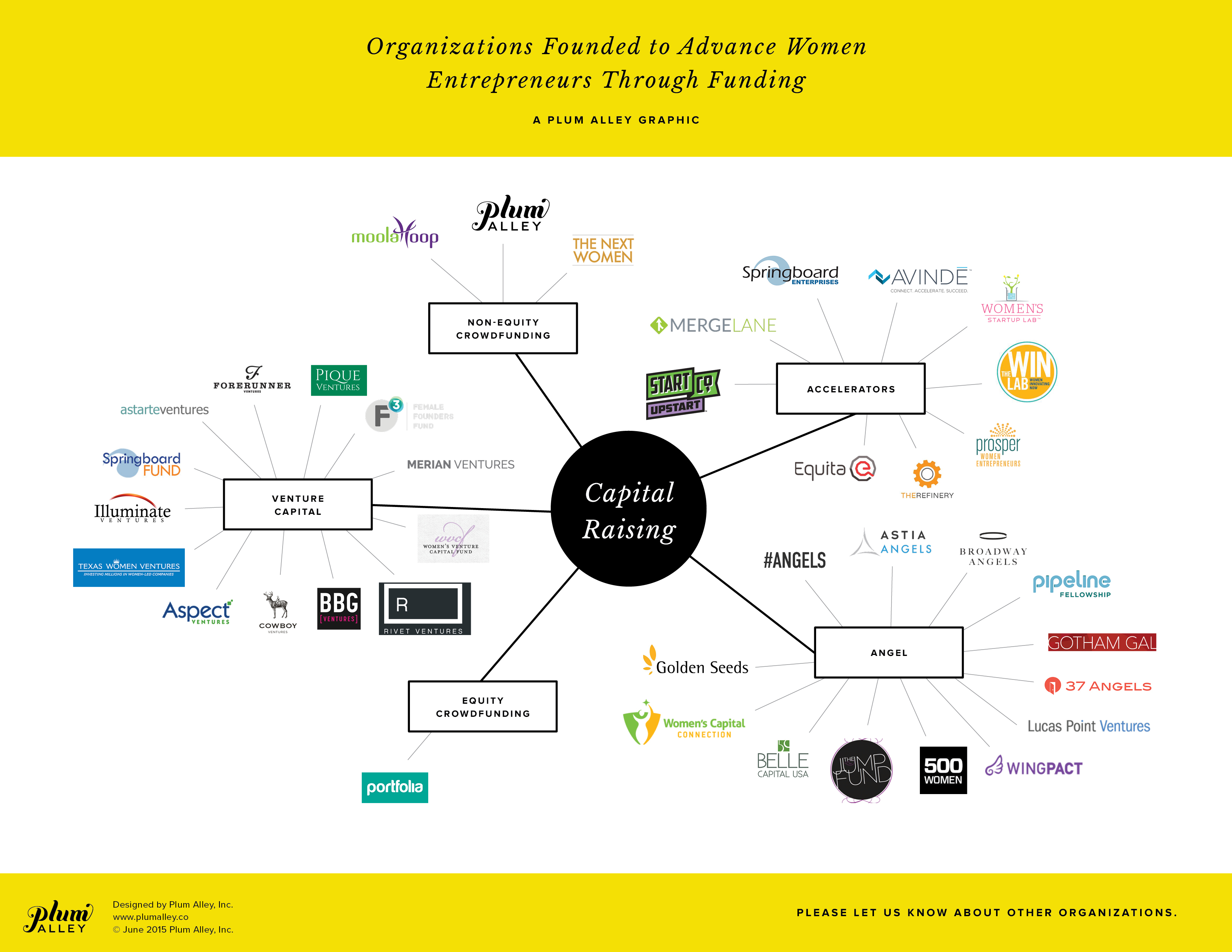
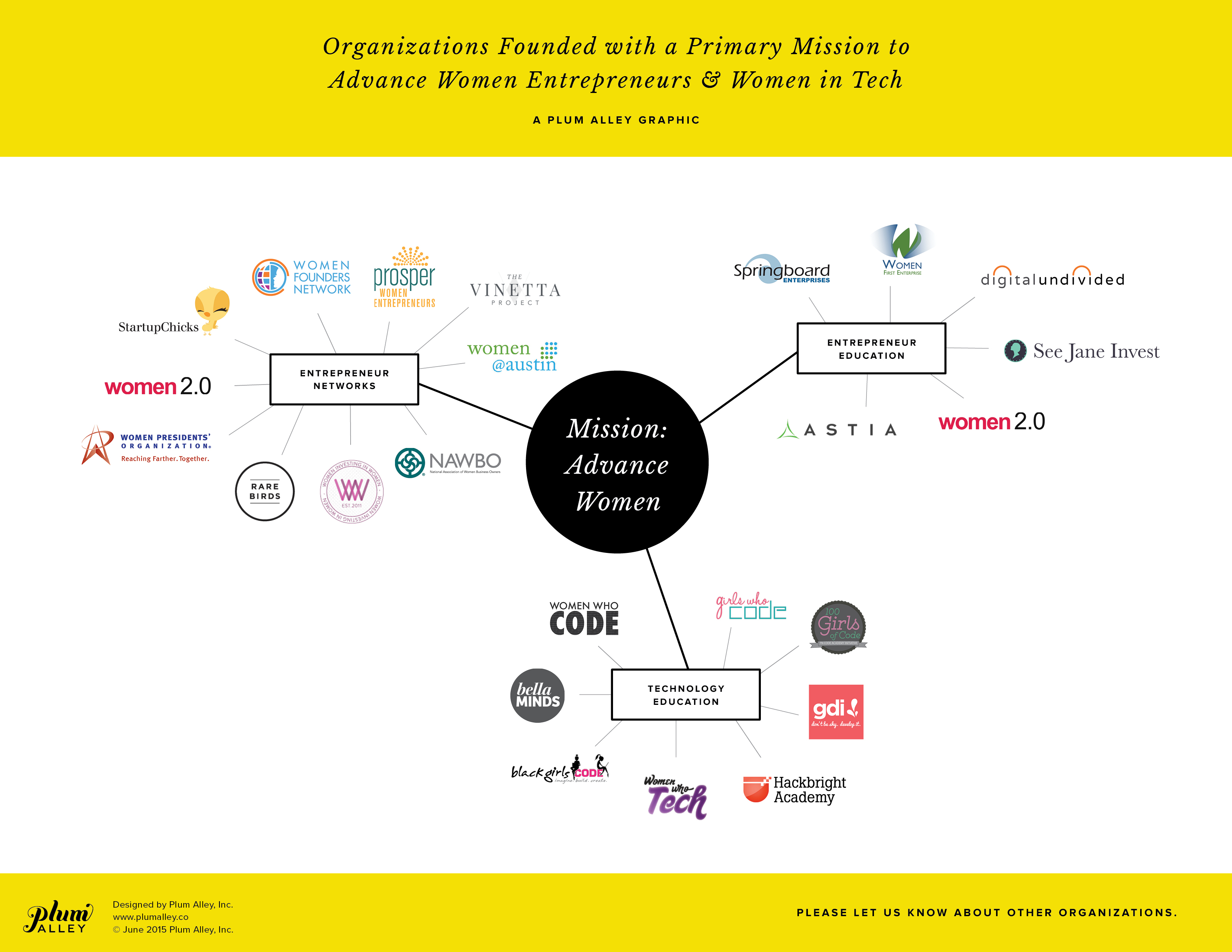
The Ecosystem for Female Entrepreneurs

There are many graphics that show the power of the male networks that supports male founders. There have been articles about the powerful and exclusive boys club. Men connect by doing business, sharing deal leads, playing sports, providing funding, and passing the hat around the table to support their buddies. It is human nature to hang with people you know and like and are similar to you. You feel comfortable and you don’t have your sense of self or ideas challenged by anyone. All of this is understandable even when it has adverse consequences.

Women of all ages are looking for ways to advance and champion each other. There are some established groups that were trailblazers as well as many new organizations springing up with purpose and commitment to open access and funding opportunity. We need all of this and more.

We have identified the organizations that have a primary and demonstrated commitment in one or more of these areas: women entrepreneurs; women building tech; women angel investors and women professional venture investors.

All of the companies and organizations in our graphic spend their time and money in the pursuit of equal access and opportunity for women and outstanding companies. This is a new age of action oriented initiatives where you use your influence and money to change things around. We did our best to include the companies we know but there are probably more to include. If you know of any additions please contact us at info@plumalley.co. Keep in mind that they have to service one or more of the 3 categories above and this has to be their primary focus. Thank you.

Deborah Jackson

Ecosystem Raising Capital

Ecosystem Support Women

Sources of Economic Hope

Rising To The Challenge

The Motivations of Female Entrepreneurs

The third infographic of our series based on data from the Kauffman Foundation’s report Sources of Economic Hope: Women’s Entrepreneurship explains why entrepreneurs don’t quit.

The hurdles are many when launching a business or venture. What keeps entrepreneurs going is the creative potential in pursuing their wildest dreams. The most common reason for starting a business is the founder’s desire to capitalize on an idea.

Entrepreneurs identify factors that have contributed to their success to varying degrees. However, the most important factors consistently involve learning from the past.

Lessons learned from previous success is tied with prior industry work experience as the most common success factor in startups.

What is notable is that learning from past mistakes is a very close third. 88.2% of respondents state that learning from wins is important, while 87.3% agree that learning from failures is also so.

Those who are truly motivated will turn “failure” into an advantage–seeing it as more of a growth map than a defeat. Founding a company requires immense determination. Those who are successful turn setbacks into opportunities to refine their goal.

The last part of our infographic explores how failure is experienced by women and men. Short summary: women value hard work whereas men trumpet self-confidence.

Sources of Economic Hope